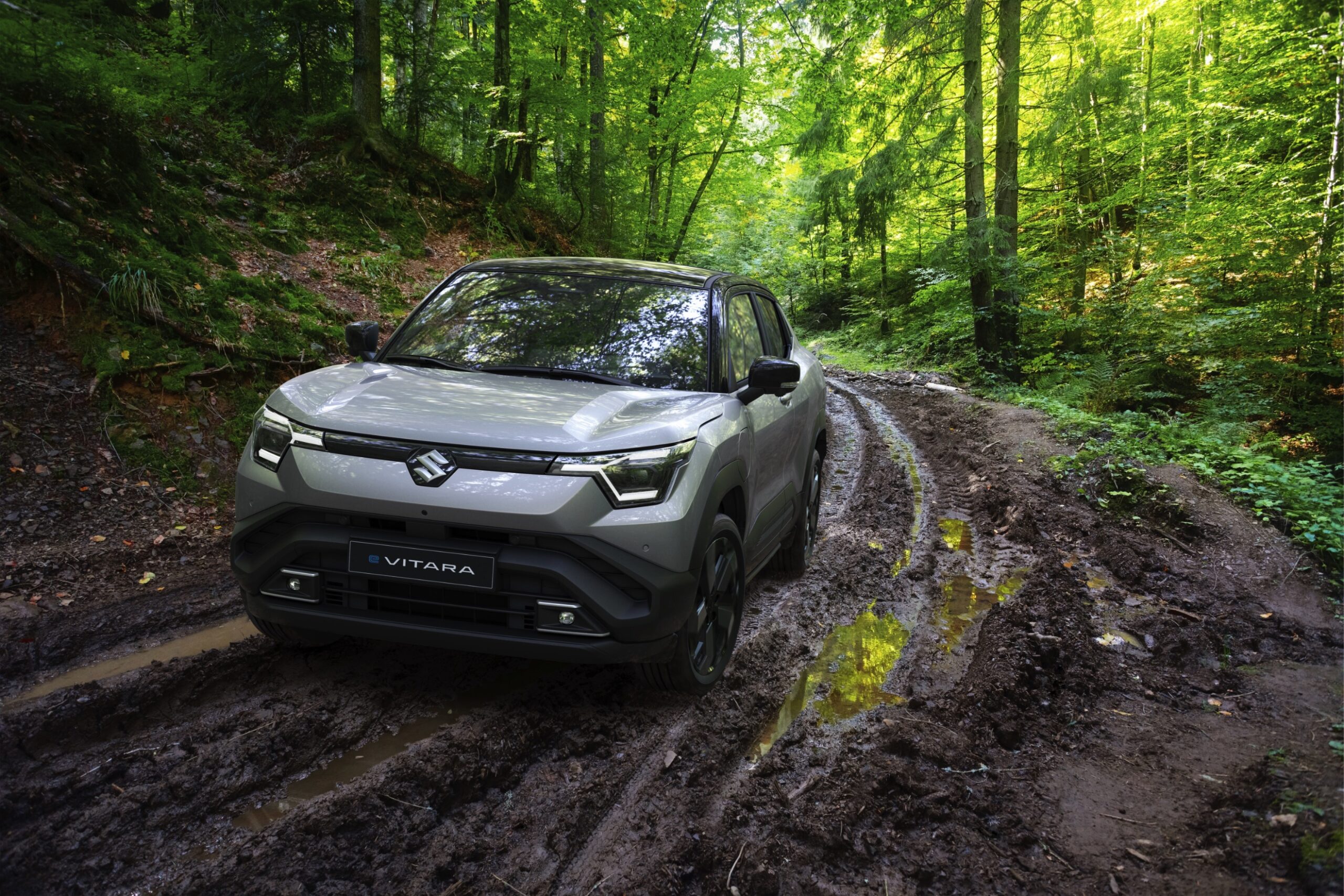
Suzuki’s first global EV has officially entered the Philippine market, bringing the familiar Vitara name into a fully electric future.
Suzuki is finally joining the local EV conversation.
At the 2026 Philippine International Motor Show, Suzuki Philippines unveiled the all-new e Vitara, the brand’s first fully production-ready global electric vehicle. For a brand better known locally for practical, affordable, and fuel-efficient models, this is a major shift.
The e Vitara is not just another crossover added to Suzuki’s lineup. It represents a new direction for the brand in the Philippines, especially as more Filipino buyers begin considering hybrids, plug-in hybrids, and full EVs.
But with a starting price of ₱2,020,000, the big question is obvious:
Is the Suzuki e Vitara worth it?
A familiar name, now fully electric
The Vitara name is not new. For years, the Vitara badge has been associated with compact SUVs that combine everyday usability with a slightly more adventurous personality. It was never the biggest or most luxurious SUV in the market, but it carried the kind of practical Suzuki identity that Filipino buyers understood.
The e Vitara takes that familiar name and moves it into a very different space. This is not a mild hybrid. It is not a fuel-saving gasoline crossover. It is a full battery-electric vehicle, which means it no longer uses a gasoline engine at all.
That alone makes it one of Suzuki Philippines’ most important launches in recent years. For a brand that built much of its local appeal on value, simplicity, and practicality, the e Vitara now asks Filipino buyers to see Suzuki in a more future-facing way.

What powers the Suzuki e Vitara?
The local Suzuki e Vitara GLX is powered by a front electric motor producing 128 kW and 193 Nm of torque. That translates to roughly 174 PS, which should be enough for daily city driving, highway cruising, and typical crossover use.
Suzuki lists a 0–100 km/h time of 8.7 seconds and a top speed of 150 km/h.
Those numbers are not meant to make the e Vitara a performance EV, but they do suggest that it should feel responsive enough for everyday use. Like many electric vehicles, the instant torque delivery will likely be one of its biggest advantages compared to a traditional gasoline crossover.
The e Vitara also uses a single-speed electric drive, which is typical for EVs. That means there is no conventional automatic transmission shifting through gears. In real-world driving, this should result in smoother acceleration and a more straightforward driving experience.

Range is the headline number
For most Filipino buyers considering an EV, range is still one of the biggest questions. Suzuki Philippines lists the e Vitara with a maximum driving range of 475 km on a full charge. The official specs also list electric energy consumption at 137 Wh/km.
A 475 km range means the e Vitara should be more than enough for daily commutes, errands, school runs, office trips, and most regular city use. It also gives the vehicle enough claimed range for some provincial drives, provided the route and charging plan make sense.
But as with any EV, real-world range will still depend on driving style, traffic, air-conditioning use, terrain, speed, passengers, cargo, and charging habits.
For Metro Manila users with home charging, the e Vitara could be easy to live with. For condo residents, renters, or buyers who rely heavily on public charging, ownership may require more planning.
That is not a Suzuki-specific issue. That is still the reality of EV ownership in the Philippines today.

Built on a dedicated EV platform
One thing that works in the e Vitara’s favor is that it is not simply a gasoline vehicle converted into an EV.
Suzuki says the e Vitara is built on its HEARTECT-e platform, a dedicated battery-electric vehicle architecture. This platform was developed with structural rigidity, passenger space, and high-voltage battery protection in mind.
Since there is no traditional engine and transmission layout to work around, engineers can better optimize cabin space, battery placement, and vehicle balance.
The e Vitara measures 4,275 mm long, 1,800 mm wide, and 1,635 mm tall, with a 2,700 mm wheelbase. Ground clearance is listed at 180 mm, while luggage capacity is rated at 306 liters with the rear seats up.
It is not a huge SUV, but it sits within a size that should be manageable for city driving while still offering enough practicality for small families or young professionals looking for a compact electric crossover.

More premium than the usual Suzuki
Inside, Suzuki is clearly trying to move the e Vitara above the usual budget-friendly image associated with the brand. The cabin features a digital cockpit layout, a 10.1-inch touchscreen, wireless Apple CarPlay and Android Auto, an Infinity sound system with six speakers and a subwoofer, a rotary shift knob, ambient lighting, and a more modern interior presentation.
The e Vitara also gets leatherette and fabric seats, a power-adjustable driver’s seat, ventilated front seats, and a 40:20:40 split-folding rear seat with sliding and reclining functions. It also shows that the e Vitara is not being positioned as a basic EV. This is not meant to be the cheapest possible electric crossover. It is meant to be a more premium, tech-forward Suzuki and that may be both its strength and its challenge.


Safety and driver assistance
Suzuki has also equipped the e Vitara with a strong set of safety features.
The local model includes Suzuki Safety Support, Dual Sensor Brake Support II, lane departure prevention, lane keep assist, blind spot monitoring, rear cross traffic alert, adaptive cruise control, multiple collision braking, adaptive high beam assist, seven airbags, all-wheel disc brakes, an electronic parking brake, and brake hold.
For a vehicle priced above ₱2 million, this level of safety equipment is important because Filipino buyers are becoming more conscious of advanced driver-assistance systems, especially in this price range. If Suzuki wants the e Vitara to be taken seriously against other electrified crossovers, it needs to offer more than just an electric powertrain.
Thankfully, on paper, the safety package looks competitive.

The ₱2.02 million question
Now comes the hard part: the price.
At ₱2,020,000, the Suzuki e Vitara is not cheap.
That is especially important because Suzuki has traditionally been associated with affordable, practical, and value-driven cars in the Philippines. Many buyers look at Suzuki for models like the S-Presso, Dzire, Ertiga, XL7, Jimny, and Carry — vehicles that often appeal because they are sensible, efficient, and relatively attainable and the e Vitara changes that conversation.
At this price point, buyers will not just ask whether it is a good Suzuki. They will ask whether it is a good electrified vehicle overall. It will be compared not only against other EVs, but also against hybrids, plug-in hybrids, and premium compact crossovers and that makes the e Vitara a more emotional and strategic purchase than a purely practical one.
You are not just buying a Suzuki crossover. You are buying into Suzuki’s first big EV statement.

Who is the e Vitara for?
The e Vitara makes the most sense for buyers who want a full EV but still value Suzuki’s practical image and it could appeal to urban drivers who have access to home charging, want lower running costs, and prefer a compact crossover that is easier to use around the city than a larger SUV.
It may also appeal to existing Suzuki fans who want to move into electrified driving without switching to a completely unfamiliar brand. But it may not be for everyone since if a buyer does not have reliable charging access, a hybrid may still be the safer choice. If the buyer wants maximum space for the money, there are gasoline and hybrid SUVs that may offer more room or stronger brand familiarity at similar price points. If the buyer is purely price-sensitive, the e Vitara may feel expensive compared to Suzuki’s usual lineup.
That is the challenge Suzuki faces.
The e Vitara is interesting, but it has to convince buyers that going fully electric with Suzuki is worth the premium.
Is it worth considering?
On paper, yes.
The Suzuki e Vitara brings a useful claimed range, respectable performance, a dedicated EV platform, a premium feature set, and a strong safety package. It also gives Suzuki Philippines a serious entry into the local EV space at a time when more Filipino buyers are becoming open to electrified vehicles. But whether it is worth ₱2.02 million depends heavily on the buyer.
If you have charging access, want to move away from gasoline, and like the idea of a compact full EV from a familiar Japanese brand, the e Vitara deserves a closer look but if you are still unsure about charging infrastructure, resale value, long-term EV maintenance, or battery ownership, then a hybrid may still feel like the more comfortable stepping stone.
That is not a weakness of the e Vitara. That is simply where the Philippine market is right now.
Final Thoughts
The Suzuki e Vitara is an important launch because it shows how quickly the local automotive market is changing.
A few years ago, the idea of Suzuki selling a ₱2-million full EV in the Philippines would have felt unusual. Today, it feels like part of a much bigger shift. Chinese brands are pushing EVs and plug-in hybrids aggressively. Japanese brands are expanding hybrid offerings. Korean brands are leaning into EV design and technology. And now Suzuki is making its own move.
The e Vitara may not be the most affordable way to enter EV ownership, but it gives Suzuki a real stake in the electrified future.
For Filipino buyers, that means more choices.
And for Suzuki, it means the Vitara name has entered a new chapter.
The question now is whether Filipino buyers are ready to see Suzuki not just as a practical car brand, but as a serious EV player.
About the Author

Kevin Peters
Kevin, or Kev, is the Founder & Editor of Road Spec PH, a passion project born from a lifelong love of cars and automotive culture.
Long before working in the Philippine automotive industry, Kevin was already the kid who collected toy cars, spent countless hours playing Gran Turismo, and proudly told anyone who would listen that he wanted to be a race car driver when he grew up. While that racing career never quite happened, the passion for cars never went away.
When he’s not writing for Road Spec PH, you’ll probably find him playing racing simulators, adding to his die-cast car collection, or spending time with his 2016 Mitsubishi Lancer EX.