
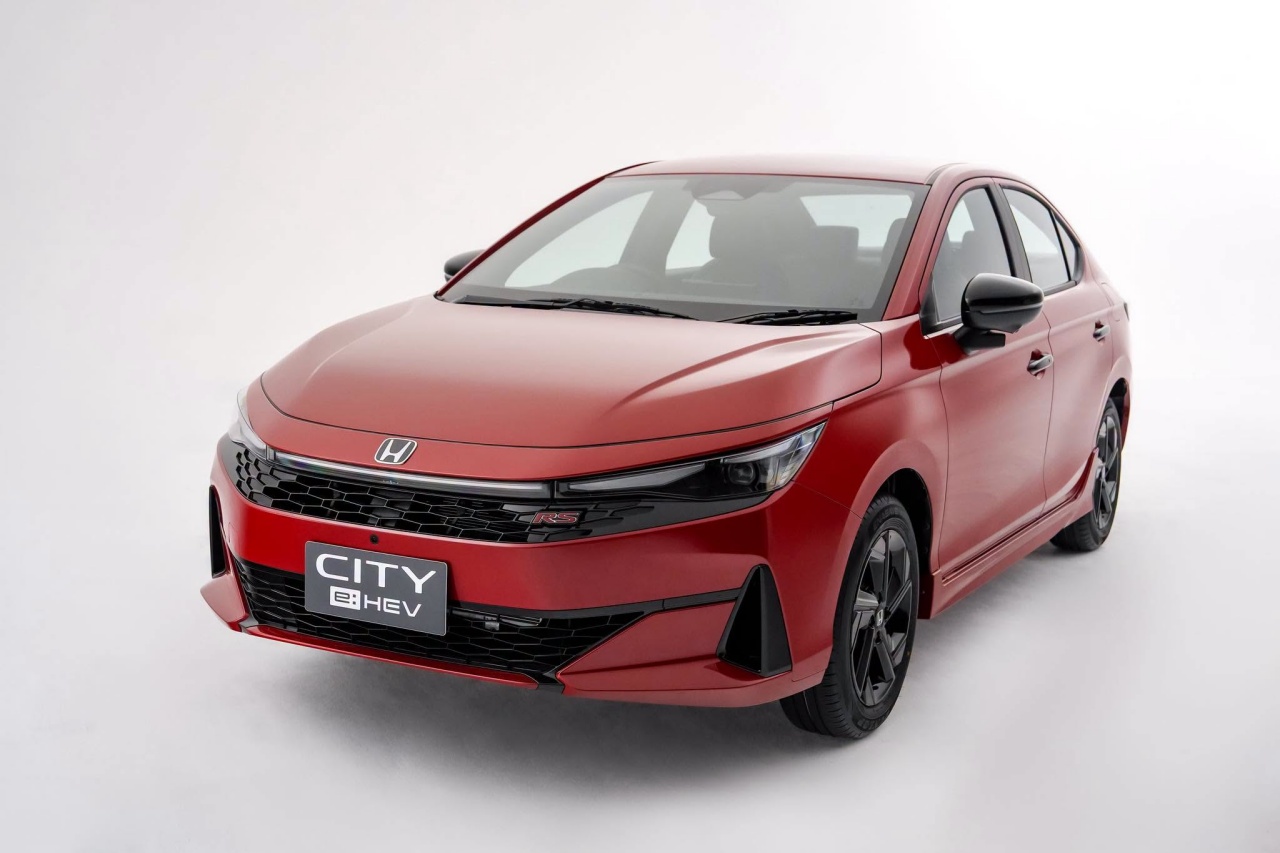
The Honda City e:HEV is starting to look less like a distant possibility and more like a regional model worth watching. Earlier this year, Honda launched the updated 2026 City in India, where the refreshed sedan made its global debut with sharper styling, added features, and the continued availability of a strong-hybrid e:HEV variant. Now, Honda has also introduced the updated City in Thailand, and this is where things become more interesting for Southeast Asian buyers.
Thailand is one of Honda’s key markets in the region, and when a model lands there, it often becomes a stronger signal that other Southeast Asian markets could eventually follow and that includes the Philippines.
For now, Honda Cars Philippines has not confirmed the City e:HEV for our market. The local City lineup remains gasoline-only. But with the updated hybrid sedan now present in both India and Thailand, it is fair to ask:
Could the Honda City e:HEV eventually reach Philippine showrooms, possibly by 2027?
The City e:HEV is already moving across key markets
The updated Honda City first appeared in India in May 2026, bringing a more comprehensive refresh to the familiar subcompact sedan. The Indian-market model continues to offer both gasoline and strong-hybrid powertrains, with the City e:HEV positioned as the top-spec hybrid variant.
Thailand followed shortly after with its own updated City lineup. Unlike India, where the e:HEV is limited to the top grade, Thailand now gives the City a stronger hybrid push. The Thai lineup includes one gasoline variant and three e:HEV variants: e:HEV V, e:HEV SV, and e:HEV RS.
It shows that Honda is not treating the City e:HEV as a one-market experiment. In Thailand, the hybrid powertrain is now a major part of the City’s identity and for the Philippines, that makes the question more interesting.

Why Thailand matters to the Philippines
The Philippine market often watches Thailand closely because many vehicles sold locally either come from Thailand or follow regional product planning influenced by Thailand’s automotive market.
That does not automatically mean every Thai-market model will come here. But when a familiar Honda nameplate gets a major update in Thailand, especially with a powertrain that fits current market trends, it becomes a reasonable candidate for future Philippine consideration.

The City is already a familiar name in the Philippines. It has long served as one of Honda’s most accessible sedans, appealing to buyers who want a practical but more refined alternative to more basic small cars.
Adding e:HEV technology could give the City a new role in Honda Cars Philippines’ lineup.
Instead of being just a gasoline subcompact sedan, it could become Honda’s most accessible hybrid model in the country.

Why a City e:HEV could make sense here
A Honda City e:HEV would arrive at a time when Filipino buyers are becoming more open to electrified vehicles.
Full EV adoption is still limited by charging access, pricing, and long-term ownership concerns. But hybrids are easier to understand. They do not require charging, they work well in traffic, and they promise better fuel efficiency without asking the buyer to change their driving habits and that is where the City e:HEV could fit well.
For everyday Philippine use, a hybrid sedan makes practical sense. City driving, stop-and-go traffic, fuel price concerns, and daily commuting are exactly the situations where a strong hybrid can feel relevant.
Honda already sells e:HEV models locally through the Civic, HR-V, and CR-V. The problem is that these models sit in higher price brackets. A City e:HEV could bring Honda’s hybrid technology closer to buyers who want electrification but are not ready to spend nearly two million pesos or more and that could make it an important bridge model.


Would Honda Philippines bring it in by 2027?
For now, there is no official confirmation.
But a 2027 Philippine arrival would not be impossible. The updated City has already appeared in India and Thailand, and Thailand’s launch is especially relevant because it places the City e:HEV within the Southeast Asian conversation.
If Honda Cars Philippines wants to expand its hybrid lineup downward, the City e:HEV is one of the most logical candidates.
It already has local nameplate recognition. It fits the market’s growing interest in fuel-efficient vehicles. It does not require charging infrastructure. And it could give Honda a stronger answer against the growing number of electrified options entering the Philippines.
Still, until Honda Cars Philippines makes an official announcement, this remains a Road Forecast rather than a confirmed launch story. For now, the City e:HEV is not confirmed for the Philippines. But after India and Thailand, it is definitely worth watching.