Priced from ₱1,499,000, the next-generation Kicks e-POWER enters the Philippines in 3 variants and 4 exterior colors.
Nissan Philippines, Inc. has officially introduced the all-new Kicks e-POWER to the Philippine market, opening the next chapter for a nameplate that helped make electrified driving feel less intimidating to Filipino motorists.
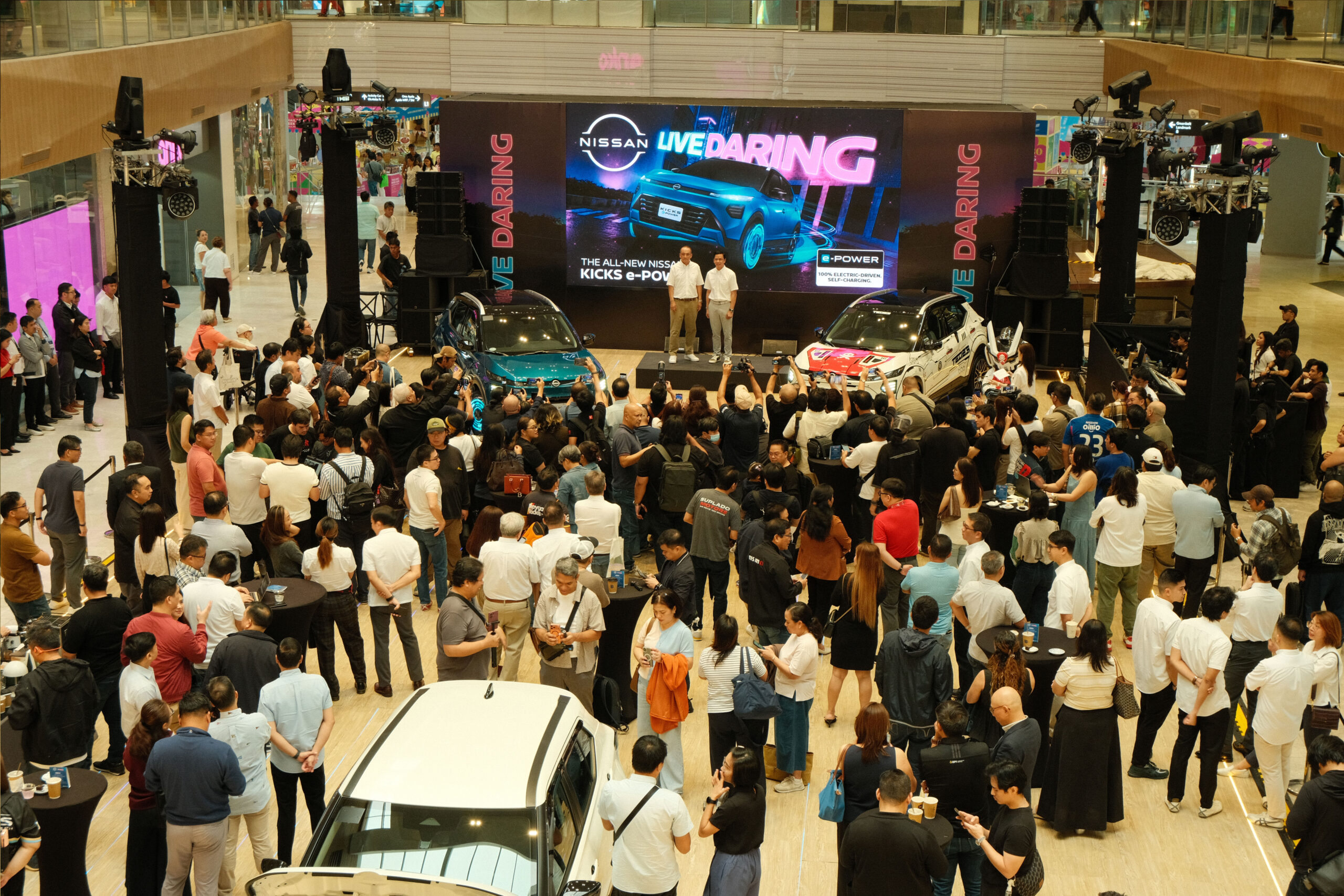
Launched on August 28, 2026, at the Glorietta Palm Drive Activity Center, the new Kicks e-POWER arrives with a completely redesigned body, a more technology-focused cabin, connected services, and an updated suite of driver-assistance systems.
Philippine pricing: the number that will define the new Kicks
The all-new Nissan Kicks e-POWER is available locally in the following variants:
- VE — ₱1,499,000* until September 30, with MSRP of ₱1,549,000
- VL — ₱1,649,000* until September 30, with MSRP of ₱1,699,000
- LE Plus — ₱1,749,000* until September 30, with MSRP of ₱1,799,000

Before it was replaced, the outgoing Kicks e-POWER’s regular Philippine range consisted of the EL, VE, and VL. Their latest widely listed prices were ₱1.179 million, ₱1.279 million, and ₱1.479 million, respectively. A Sport offering also appeared during the previous model’s life, adding another styling-oriented choice around the VE’s position.
That gives the new Kicks a clearly established benchmark. Its entry price is now ₱320,000* more than the old EL, while the flagship costs ₱270,000* more than the former VL.
Same Variant Count, Updated Lineup
For an apples-to-apples comparison, the outgoing Kicks ended its run with three regular grades—EL, VE, and VL—although a Sport variant was also offered during the generation’s life. The all-new model therefore keeps the same number of regular variant choices, while reshuffling the lineup with updated equipment and positioning.


The biggest takeaway is that all three variants have the same e-POWER drivetrain, dimensions, chassis, wheels, cabin capacity, and most core safety systems. Moving up the range primarily adds infotainment, parking assistance, connectivity, comfort equipment, and—on the LE Plus—ProPILOT.
The comparison below is based on Nissan’s official Philippine specifications and features table.
| VE | VL | LE Plus | |
|---|---|---|---|
| Launch promotional price | ₱1,499,000 | ₱1,649,000 | ₱1,749,000 |
| Premium over VE | — | ₱150,000 | ₱250,000 |
| Curb weight | 1,360 kg | 1,364 kg | 1,365 kg |
| 12.3-inch Display Audio | No/not specified | Yes | Yes |
| Speakers | 4 | 6 | 6 |
| Around View Monitor | No | Yes | Yes, with Moving Object Detection |
| Rear parking sensors | No | Yes | Yes |
| Rear Automatic Emergency Braking | No | Yes | Yes |
| ProPILOT | No | No | Yes |
| Intelligent Rear View Mirror | No | No | Yes |
| NissanConnect Services | No | No | Yes |
| Wireless charger | No | No | Yes |
| Power-adjustable driver’s seat | No | No | Yes |
| Black Roof | No | No | Yes |
| Interior color | Black and Dark Gray | Black and Dark Gray | Moonstone |
The prices are introductory promotional prices valid until September 30, 2026.
The variant that appears to offer the strongest value is the VL because its ₱150,000 premium over the VE adds the 12.3-inch Display Audio, six speakers, Intelligent Around View Monitor, rear parking sensors, and Rear Automatic Emergency Braking while retaining the same 136-PS, 280-Nm e-POWER drivetrain as the LE Plus. It misses the flagship’s ProPILOT and NissanConnect features, but covers the equipment upgrades likely to matter most in everyday use.
Color is more than a brochure detail
The all-new Kicks e-POWER is available in four (4) Philippine-market exterior colors:


Two-tone combinations are available in LE Plus, pairing the body with a black roof.
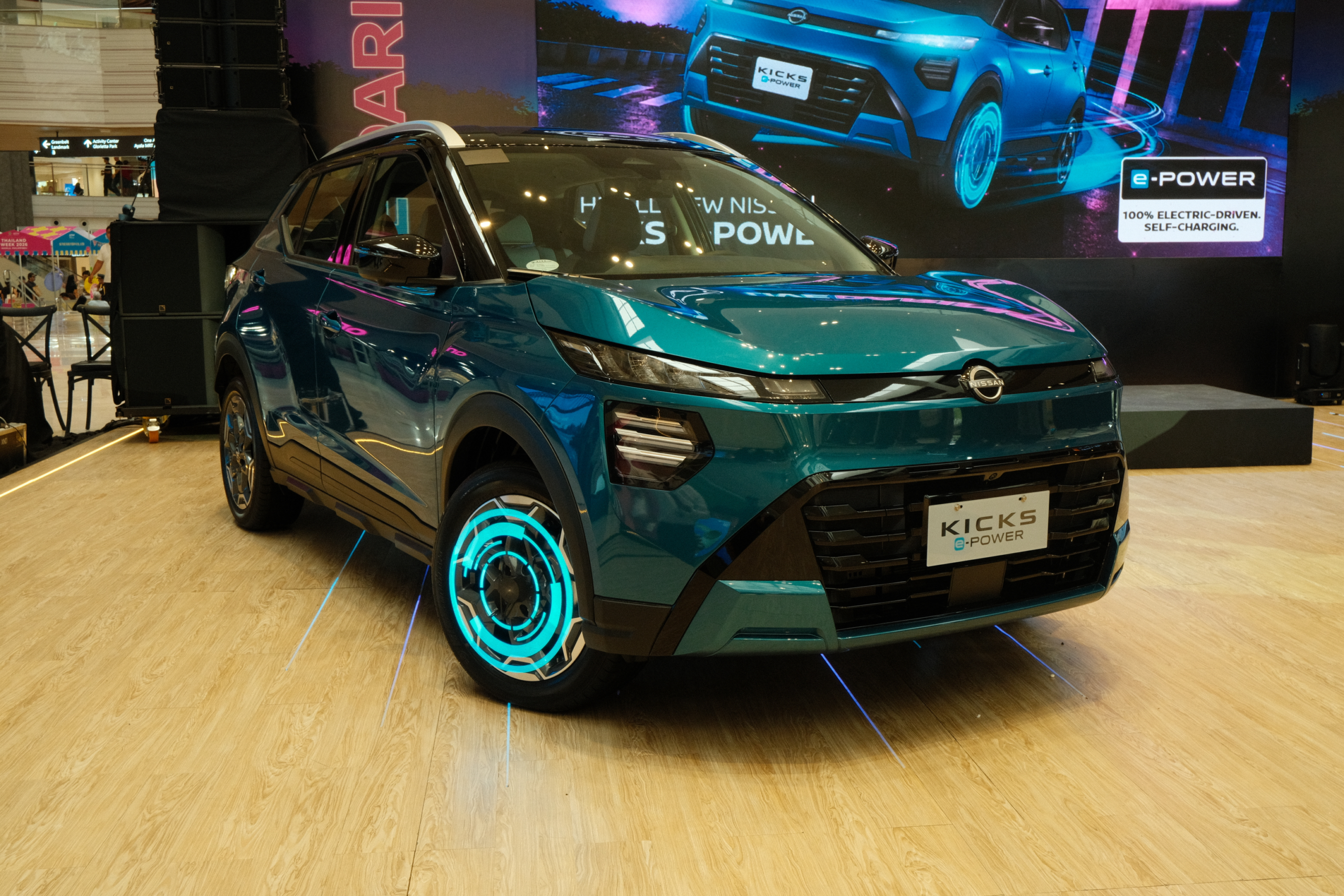
The launch color, Aquamarine Metallic, is likely to become the shade most closely associated with this generation. Under the mall’s event lighting, it looked striking without feeling overly attention-seeking, and the metallic finish gave the blue a distinctive character that felt different from the more familiar blues used by brands like Ford or Subaru. The way the light played across the paint also gave it a subtly futuristic, electrified feel—something that, on the road, should make the Kicks look fresh without trying too hard.
More conservative choices such as Pearl White, and Gun Metallic will probably account for much of the volume, but the availability of the Moon Pearl Gray (which is the signature exterior color of the top-of-the-line Nissan Almera) gives buyers an option that does not disappear into the increasingly crowded crossover landscape.

The Interior seat materials all come with their Heat Tech leather with Moonstone color option reserved for the LE Plus variant.
e-POWER remains the heart of the experience
The all-new Kicks continues to use Nissan’s e-POWER system, in which the wheels are driven exclusively by an electric motor. A gasoline engine is carried onboard, but instead of mechanically driving the wheels in the conventional sense, it generates electricity for the battery and motor.

Nissan Philippines has confirmed 136 PS and 280 Nm for the new model. Those numbers will sound familiar because they are effectively the same headline outputs advertised for the outgoing Philippine Kicks e-POWER.
It uses a 1.2-liter three-cylinder, 12-valve CVTC gasoline generator paired with a 2.06-kWh lithium-ion battery and carries a fuel-efficiency rating of 21.7 km/L. Combined with its 41-liter fuel tank, that translates to a theoretical driving range of approximately 890 km on a full tank, although actual consumption and range will vary with traffic, driving style, and road conditions.
Familiar output, but a more mature execution
Because maximum output remains at 136 PS and 280 Nm, the new Kicks is not chasing progress through a larger number on the brochure. Nissan’s argument is instead built around refinement and usability.
The e-Pedal Step function also returns, allowing the driver to slow the vehicle more assertively by easing off the accelerator. Unlike a true one-pedal mode that can bring some EVs to a complete stop, e-Pedal Step is intended to reduce how frequently the brake pedal is needed while maintaining predictable low-speed behavior.
Available driving modes include Eco, Normal, and Sport and is the same from the outgoing model.
A bolder Kicks without losing its urban proportions
The exterior is a decisive break from the rounded shape of the outgoing model.

Up front, the new Kicks adopts a wider and more upright visual treatment, anchored by Nissan’s signature V-Motion grille and a redesigned lighting signature. All three variants receive full LED headlamps with manual leveling, automatic on/off operation, and a Follow Me Home function. Nissan says the improved headlights provide wider and longer illumination for better visibility in low-light conditions. The VL and LE Plus add distinctive triple-arrow LED daytime running lights, giving the upper portion of the fascia a sharper and more technical appearance, while the VE uses a simpler LED daytime-running-light treatment.

The side profile is cleaner but more geometric. Strong body surfacing, pronounced wheel arches, and a more deliberate relationship between the roof and rear pillars give it a sturdier stance without turning it into an oversized SUV.

All Philippine variants ride on 17-inch alloy wheels wrapped in 205/55 R17 tires, with Nissan’s official specifications listing no variant-specific differences in wheel size, design, or finish.

At the rear, the new Kicks moves away from the outgoing model’s distinctive boomerang taillights in favor of slimmer, more horizontal LEDs connected visually by a gloss-black panel. Together with the larger spaced-out KICKS lettering and more sculpted bumper, the result looks wider and noticeably more modern, with the segmented light signature giving the rear an almost EV-like character.
The Philippine-spec Kicks measures 4,300 mm long, 1,760 mm wide, and 1,615 mm tall, with a 2,620-mm wheelbase and 180 mm of ground clearance.

A cabin designed around screens and everyday usability
The redesigned cabin may be one of the clearest areas of progress.

Depending on variant, the Philippine Kicks receives a 12.3-inch touchscreen Display Audio system, fitted to the VL and LE Plus, while Nissan’s official brochure does not specify the infotainment-screen size used by the VE. All three variants receive a seven-inch fully digital TFT instrument display with a digital speedometer.
The 12.3-inch system supports wireless Apple CarPlay and Android Auto. Every variant also receives a front USB Type-C port alongside a 12-volt socket and another USB Type-C connection for rear passengers.
The VL and LE Plus upgrade from the VE’s four-speaker system to six speakers. The LE Plus adds a wireless phone charger, Intelligent Rear View Mirror, and NissanConnect Services with smartphone-based vehicle monitoring, security alerts, and remote controls.

All variants are equipped with Nissan’s Zero Gravity front seats. The LE Plus receives a six-way power-adjustable driver’s seat with height adjustment, while the VE and VL use a manual six-way driver’s seat. The front-passenger seat remains manually adjustable in four directions across the range.

Nissan says the Zero Gravity design supports a more comfortable seating position and helps reduce fatigue, while the anti-heat upholstery is intended to limit heat buildup under the sun. A firmer judgment on cushioning and long-distance support will require more time behind the wheel.
NissanConnect brings the Kicks properly online
NissanConnect Services is one of the new model’s most significant upgrades for the Philippine market.

Through a compatible smartphone, owners can access NissanConnect functions including Automatic Collision Notification, an SOS Emergency Call button, My Car Finder, remote engine start and stop, remote door locking and unlocking, remote horn and light activation, Vehicle Health Reports, maintenance alerts and reminders, Driving and Journey History, and Speed, Curfew, Zone, and Theft Alerts.
NissanConnect Services is standard exclusively on the LE Plus. It is not listed as standard or optional equipment on the VE and VL, although all three variants retain remote engine start and stop through the vehicle’s regular remote-control system.
The LE Plus includes a three-year NissanConnect Services subscription. Nissan Philippines has not disclosed the renewal price, post-subscription arrangement, or whether individual connected functions will be offered through separate service packages after the complimentary period ends.
How much safety technology reaches each variant?
At the Philippine launch, Nissan said the all-new Kicks e-POWER introduces 10 new Nissan Intelligent Mobility features, bringing its total to 16. More importantly, a substantial portion of that safety package is fitted across all three variants rather than being reserved entirely for the flagship.

Every Philippine-spec Kicks receives six airbags covering the driver, front passenger, front-seat sides, and both curtain areas. Standard safety equipment also includes anti-lock brakes, brake assist, Vehicle Dynamic Control, traction control, a Tire Pressure Monitoring System, an alarm with engine immobilizer, a reversing camera, a high-mounted stop lamp, and ISOFIX child-seat and tether anchors for the second row.
Across the complete range, Nissan Intelligent Mobility equipment includes:
- ProPILOT
- Intelligent Cruise Control
- Lead Car Departure Notification
- Intelligent Around View Monitor
- Intelligent Rear View Mirror
- Intelligent Forward Collision Warning
- Intelligent Forward Emergency Braking with Pedestrian Detection
- Lane Departure Warning
- Intelligent Lane Intervention
- Blind Spot Warning
- Blind Spot Intervention
- Rear Cross Traffic Alert
- Rear Automatic Emergency Braking
- High Beam Assist
- Driver Attention Alert
The Tire Pressure Monitoring System (TPMS) is listed separately under Safety and Security in Nissan’s brochure. Including it brings the total to 16 technologies.
As always, these systems assist the driver; they do not make the Kicks autonomous. Their real value will depend on calibration—warnings must arrive early enough to help without becoming so intrusive that owners are tempted to disable them.
The variant that makes the most sense
On paper, the VL appears to be the sweet spot of the Philippine range.
At its introductory price of ₱1,649,000, it costs ₱150,000 more than the VE but adds several upgrades that owners will regularly use: the 12.3-inch Display Audio with wireless Apple CarPlay and Android Auto, a six-speaker system, triple-arrow LED daytime running lights, an Intelligent Around View Monitor, rear parking sensors, and Rear Automatic Emergency Braking.

The VL gives up the LE Plus’ ProPILOT system, Intelligent Rear View Mirror, NissanConnect Services, wireless charger, six-way power-adjustable driver’s seat, Moving Object Detection, Moonstone interior, roof rails, and two-tone Black Roof treatment. In return, it saves ₱100,000 while retaining the same 136-PS, 280-Nm e-POWER drivetrain, dimensions, wheels, and most of the Kicks’ core driver-assistance systems.
The top-spec LE Plus makes its strongest case through technology and presentation. For ₱1,749,000, it adds ProPILOT with Traffic Jam Assist and Lane Keep Assist, NissanConnect smartphone services, an Intelligent Rear View Mirror, Around View Monitor with Moving Object Detection, wireless charging, a power-adjustable driver’s seat, and a more distinctive Moonstone interior with an exclusive Black Roof. These features make the LE Plus the most complete Kicks, although they do not provide any additional power or mechanical capability over the lower variants.
Prices stated are Nissan’s introductory promotional prices valid until September 30, 2026.
Ownership details that should not be overlooked
Warranty coverage carries over from the outgoing model, with Nissan providing a five-year general vehicle warranty and an eight-year warranty for the lithium-ion battery. The launch offer additionally includes a complimentary one-year Nissan Protect+ prepaid-maintenance package using genuine Nissan oil and parts.

The Kicks now enters a much tougher market
When the first Philippine Kicks e-POWER arrived in 2022, its drivetrain made it one of the most unusual products in its class.
The market in 2026 is very different. Buyers now have access to more conventional hybrids, plug-in hybrids, range-extender vehicles, and full EVs across a wider range of prices. Several newer brands also compete aggressively through long equipment lists and headline-grabbing launch offers.
The Kicks still has a distinctive mechanical proposition. Its wheels are always driven by an electric motor, yet owners refuel it like a conventional gasoline vehicle. It offers much of the immediate response associated with an EV without asking the buyer to install a home charger or plan journeys around public charging stations.

That advantage remains easy to understand. What is harder is translating it into value when rivals may offer more cabin space, longer warranties, lower prices, or different forms of electrification.
This is why pricing and variant structure carry so much weight. The new Kicks does not need to be the cheapest electrified crossover, but it must make a convincing argument that its electric-motor driving character, Nissan ownership support, safety technology, and overall refinement are worth the difference.
A more complete Kicks, with the final verdict still to come
The all-new Nissan Kicks e-POWER appears to address several areas where the outgoing model had begun to show its age.
Its exterior has more presence. The cabin looks more contemporary. NissanConnect Services moves it closer to what buyers expect from a modern connected vehicle, while the expanded driver-assistance technology gives the new generation a stronger safety story.


Its 136 PS and 280 Nm outputs do not represent an increase over the outgoing Kicks, but they do not necessarily need to. The original model’s appeal was never based purely on winning a horsepower contest. It came from the smoothness and immediacy of an electric motor combined with the familiarity of gasoline refueling.
The bigger question is whether Nissan has improved everything around that drivetrain—and whether it has priced those improvements sensibly.
A full verdict will require a proper drive on Philippine roads, where traffic, rough surfaces, heat, gradients, and longer high-speed sections can reveal details that a launch display cannot. For now, the new Kicks e-POWER looks like a more complete and more mature expression of Nissan’s motor-driven electrified crossover.
Whether it becomes the new benchmark will depend not only on how it drives, but on how convincingly each peso has been spent.