Tag: Mitsubishi Pajero

  • From XForce to Pajero: Could the Mitsubishi Triton Be Next for the Brand’s New Look?

    From XForce to Pajero: Could the Mitsubishi Triton Be Next for the Brand’s New Look?

    Mitsubishi Motors’ newest SUVs give us a reason to look again at the Mitsubishi Triton. Across the XForce, Destinator, and newly revealed Pajero, distinctive lighting and strong horizontal lines create an increasingly recognizable family resemblance. For Philippine pickup buyers, that raises an interesting question: could a future Triton update bring those ideas into the truck’s design?

    As of September 7, 2026, we have found no official announcement of a Pajero-inspired facelift for the Philippine-market Triton. This feature examines Mitsubishi’s confirmed production designs; the proposed Triton changes are Road Spec PH analysis.

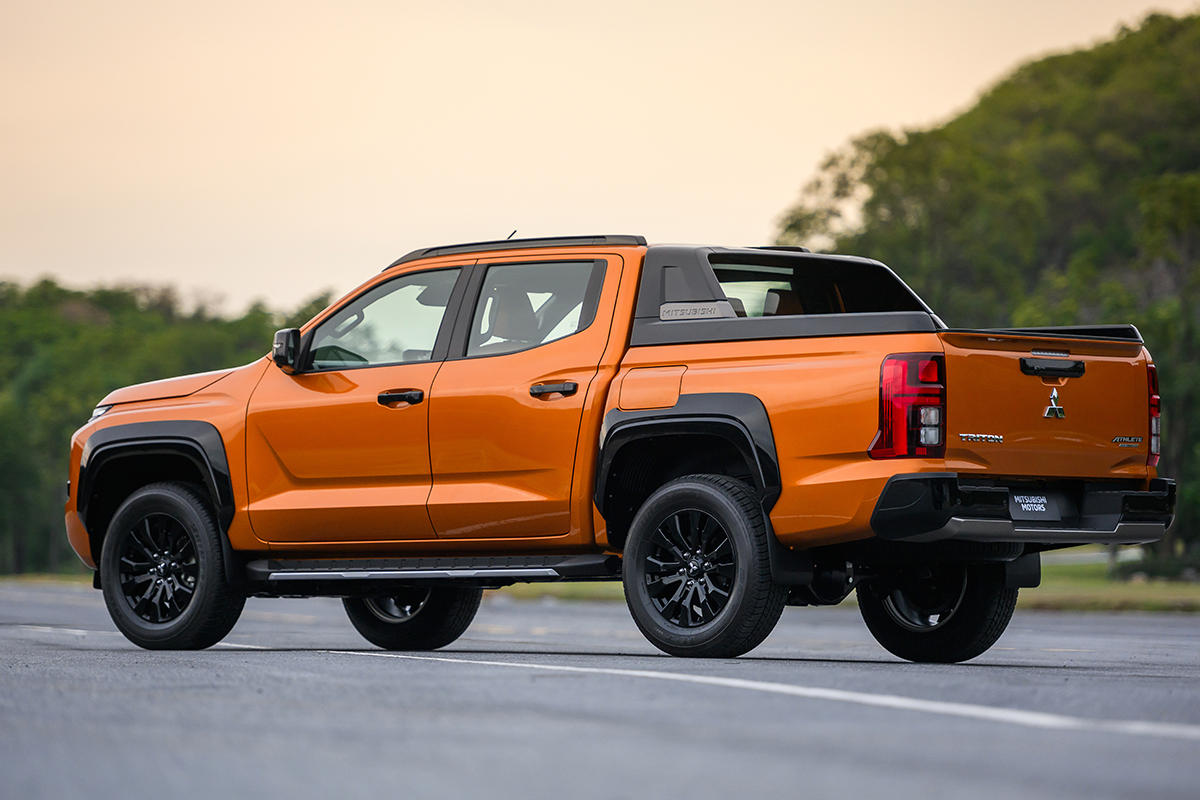
    Disclaimer: This image is an AI-generated concept created for illustrative purposes only. It is not an official Mitsubishi design or preview of a confirmed Triton update.

    Mitsubishi’s family resemblance is becoming clearer

    The XForce offers an early reference point. Mitsubishi describes its front as an evolution of Dynamic Shield, with daytime running lights that combine L-shaped elements and slitted accents into a T-shaped signature. The rear lights repeat that motif, giving the compact SUV a recognizable appearance from either direction.

    Photo : Mitsubishi Motors

    The Destinator develops that approach through stronger horizontal and vertical elements around its grille, lights, and bumpers. Mitsubishi also connects its hexagonal rear design to the spare tires carried by earlier Pajeros. That provides a deliberate link between the brand’s newer family vehicles and its off-road heritage.

    Photo : Mitsubishi Motors

    The new Pajero brings upright proportions, prominent fenders, T-shaped headlights, and a choice of horizontal-bar or honeycomb grilles. Our reading is that these models share an emphasis on width and clearly defined shapes, even though each applies those ideas differently. A future Triton could strengthen its resemblance to that family while retaining the proportions and character of a pickup.

    Photo : Mitsubishi Motors

    The current truck already participates in that design language. Its sixth generation debuted in July 2023 with Mitsubishi’s Beast Mode design concept, three L-shaped daytime running lights on each side, and T-shaped rear lights. Any future adoption of a stronger T-shaped lighting signature would therefore be an evolution of existing themes, particularly at the front.

    The Pajero–Triton connection goes beneath the bodywork

    There is a confirmed engineering relationship behind this discussion. Mitsubishi’s earlier Pajero announcement states that the SUV uses the Triton’s ladder frame as its foundation, with model-specific development of the cabin and front and rear suspension. That makes the two vehicles relevant points of comparison, although shared foundations do not establish a plan to exchange body panels or equipment.

    Photo : Mitsubishi Motors

    For an eventual facelift, we would look first at how Mitsubishi might reorganize the Triton’s grille, lighting, and bumper. A more continuous horizontal treatment could visually connect the lamps, while a different arrangement of the protective trim could give the nose a cleaner appearance. Those are possible directions for the design, with no confirmed production changes behind them.

    Mitsubishi has already demonstrated that the current Triton can accommodate a different front-end treatment. The Thailand-exclusive Triton Mega Cab Street has its own grille design and 17-inch wheels, along with a 10-inch infotainment system. It is an existing market-specific version, so its appearance does not confirm a broader facelift or a Philippine introduction.

    At the rear, revised lighting graphics and tailgate detailing could create a closer visual relationship with Mitsubishi’s newer SUVs. Different wheels and finishes could also distinguish the grades. We would want those changes to preserve useful bumper steps, cargo access, and the visibility of the lamps—details that matter once the truck starts working.

    The cabin and drivetrain deserve attention, too

    The Philippine Triton Athlete currently lists a 9-inch touchscreen, a 4N16 diesel engine, a six-speed automatic, and Super Select 4WD-II. Those provide a concrete starting point when considering what Mitsubishi Motors Philippines Corporation’s pickup customers might want from a future update. A larger display could be welcome, particularly if it improves the readability of maps and camera views.

    Photo : Mitsubishi Motors

    The Pajero’s integrated display arrangement offers another possible source of inspiration. However, fitting its complete dashboard into the Triton would be a much bigger proposition than updating the infotainment system or instrument graphics. Our preference would be for clearer information and responsive controls, with frequently used functions remaining easy to operate.

    The drivetrain comparison is also worth watching. Mitsubishi confirms that the new Pajero pairs a 2.4-liter diesel using a wide-range single variable-geometry turbocharger with a newly developed eight-speed automatic. That invites questions about whether later Triton development could draw on similar hardware, but the Pajero announcement does not confirm such a transfer.

    Photo : Mitsubishi Motors

    An additional two gears alone would not tell buyers whether an updated pickup drives better. Shift behavior, response under load, cruising refinement, and fuel consumption would matter more in daily use. Those qualities would need to be assessed in an actual production vehicle.

    What would make a future Triton update worthwhile in the Philippines?

    For Philippine buyers, a more cohesive design would be an appealing starting point. Its value would depend on the equipment and price attached to it, particularly across the grades that people can realistically afford. A refreshed flagship would attract attention, but useful improvements reaching more of the range would give buyers a stronger reason to consider the truck.

    Our wishlist would include better camera visibility, straightforward smartphone connectivity, comfortable seating, and driver-assistance systems that work predictably in local traffic. We would also want Mitsubishi to retain the practical details that make a pickup easy to live with. An impressive cabin still needs to accommodate work gear, muddy footwear, and regular loading duties.

    The new Pajero makes the Triton’s eventual evolution an interesting design question. Its connection to the pickup gives us something concrete to examine, while the XForce and Destinator show how Mitsubishi adapts recognizable motifs to different vehicles. A future Triton could take that family resemblance further, provided the result still serves the people buying a truck.

    Would you prefer a Triton with more of the Pajero’s appearance—or would cabin technology, refinement, and pricing have a greater influence on your decision?

  • A Legend Revived: The All-New Mitsubishi Pajero Makes Its Global Debut

    A Legend Revived: The All-New Mitsubishi Pajero Makes Its Global Debut

    After five years away from global production, the Mitsubishi Pajero is back—not merely as a heritage exercise, but as the new flagship of Mitsubishi Motors Corporation.

    Mitsubishi officially unveiled the fully redesigned Pajero on September 2, 2026, opening a new chapter for a name that helped define the recreational SUV long before the market became crowded with lifestyle-oriented crossovers. Known as the Montero in certain countries, the returning model combines a Triton-derived ladder frame with a seven-seat cabin, Super Select 4WD-II, S-AWC, and a more deliberate move into premium SUV territory.

    Production will take place at Mitsubishi’s manufacturing base in Thailand. The Pajero will launch first in Thailand, followed by Japan and Australia within fiscal year 2026, which runs until March 2027.

    Beginning in fiscal 2027, Mitsubishi plans to introduce the Pajero in approximately 100 countries across ASEAN, Latin America, the Middle East, and other regions. Mitsubishi Motors Philippines Corporation has not yet confirmed whether the Philippines is included in that rollout.

    Photo : Mitsubishi

    A name that helped shape Mitsubishi’s identity

    The first Mitsubishi Pajero arrived in 1982 with what was then an unusual proposition: combine the ruggedness and reliability of a serious four-wheel-drive vehicle with enough comfort and drivability for ordinary family travel.

    Four generations followed, with cumulative production exceeding 3.29 million units and the Pajero reaching customers in more than 170 countries and regions. Its reputation was reinforced in competition through 12 Dakar Rally victories, including seven consecutive wins.

    Production for the Japanese market ended in 2019, while overseas production continued until 2021. Its return therefore comes after seven years in Japan and five years globally.

    Photo : Mitsubishi

    The revival also arrives at a significant moment for Mitsubishi. Under its current mid- to long-term strategy, the company wants to focus on products that embody what it describes as “Mitsubishi Motors-ness”: off-road capability, durability, reliability, safety, comfort, and the confidence to continue when the road becomes difficult.

    Mitsubishi is not presenting the Pajero as just another seven-seat SUV. It calls the vehicle its new-generation flagship and intends to use it as the foundation of a broader Pajero series in the years ahead.

    That brings considerable weight to the badge. A revival can draw attention through nostalgia, but it can only preserve the Pajero name by demonstrating that its engineering, capability, and ownership experience deserve the association.

    Photo : Mitsubishi

    Heritage expressed through a modern shape

    Mitsubishi calls the new Pajero’s design concept “Grand Charisma.” Its upright proportions and strong horizontal lines reference the stance of earlier generations, while pronounced fenders and heavily sculpted body surfaces give the vehicle the visual mass expected from a modern flagship SUV.

    Two grille treatments have been developed. One uses horizontal bars intended to reflect the precision of Japanese craftsmanship, while the other adopts a more functional-looking honeycomb pattern.

    Both are incorporated into Mitsubishi’s latest Dynamic Shield design language. The front is framed by recessed T-shaped LED headlights, an arrangement that recalls how the first-generation Pajero positioned its lights farther inward to protect them from obstacles during off-road driving.

    The same T-shaped theme appears in the rear lighting. Mitsubishi has also incorporated a C-pillar treatment inspired by the first Pajero’s external roll bar and a hexagonal tailgate motif that reinterprets the rear-mounted spare wheel used by earlier models.

    Photo : Mitsubishi

    The spare wheel itself has been moved underneath the vehicle. This allows Mitsubishi to retain a visual reference to the old Pajero while freeing more space for luggage and improving the packaging around the third row.

    Mitsubishi has highlighted two principal launch colors. Armor Copper Metallic is intended to emphasize the body’s thick and substantial surfaces, while Phantom Blue Metallic uses a grayish-blue base with gold highlights that become more visible as the light changes.

    Photo : Mitsubishi

    A traditional foundation with considerably more control

    Underneath the new body is a highly rigid ladder frame related to the latest Mitsubishi Triton. Mitsubishi says the Pajero receives its own cabin structure, body mounting, suspension development, and tuning rather than simply placing a new upper body over an unchanged pickup platform.

    Photo : Mitsubishi

    The new architecture marks an important change from the third- and fourth-generation Pajero, which used a built-in frame monocoque construction. Mitsubishi has returned to a conventional ladder-frame foundation while attempting to retain the ride quality and handling expected from a flagship.

    High-tensile steel is used more extensively to control weight, while enlarged frame sections improve torsional and bending rigidity. Strengthened body mounts are intended to reduce vibrations entering the passenger compartment on rough roads.

    Photo : Mitsubishi

    The front suspension uses an independent high-mounted double-wishbone design. At the rear is a newly developed five-link rigid-axle arrangement, with long suspension travel and geometry intended to maintain tire contact over uneven terrain.

    Mitsubishi describes “off-road comfort” as one of the Pajero’s key development targets. That means controlling impacts, vibration, body movement, and even intrusive braking-system noise instead of treating discomfort as an unavoidable consequence of off-road capability.

    Photo : Mitsubishi

    A 2.4-liter diesel and a new eight-speed automatic

    The all-new Pajero uses a specially developed 2.4-liter clean-diesel engine equipped with a wide-range single variable-geometry turbocharger.

    Mitsubishi quotes maximum torque of 480 Nm, although the global announcement notes that selected specifications will produce 470 Nm. Maximum power was not stated in the global release and may vary between markets.

    The diesel is paired with a newly developed eight-speed automatic transmission with Sport mode. Compared with the six-speed automatic used by the related Triton in several markets, the additional ratios should give Mitsubishi more freedom to balance low-speed response, highway refinement, fuel consumption, and off-road control.

    Mitsubishi has not yet released official fuel-consumption figures.

    Photo : Mitsubishi

    Super Select 4WD-II meets S-AWC

    The Pajero combines Mitsubishi’s Super Select 4WD-II hardware with the broader control of Super-All Wheel Control.

    Super Select 4WD-II gives the driver four selectable configurations:

    • 2H: rear-wheel drive
    • 4H: full-time four-wheel drive
    • 4HLc: four-wheel drive with the center differential locked
    • 4LLc: locked center differential with low-range gearing

    S-AWC coordinates the four-wheel-drive system with Active Yaw Control, Active Stability and Traction Control, and the anti-lock braking system. Active Yaw Control uses the front brakes to influence left-to-right torque distribution, helping the Pajero respond more naturally during acceleration, cornering, and changes in grip.

    Seven drive modes are provided: Normal, Eco, Gravel, Snow, Mud, Sand, and Rock. The system alters the vehicle’s control strategy to suit different surfaces rather than expecting the driver to manage every mechanical response manually.

    Mitsubishi has also fitted large 18-inch brake rotors and an electric brake booster. The published dimensions and off-road measurements apply to vehicles fitted with 20-inch tires, although complete wheel and tire specifications by grade have not yet been disclosed.

    Photo : Mitsubishi

    A seven-seat flagship cabin

    The Pajero’s interior continues the exterior’s horizontal theme. Its dashboard takes inspiration from the first-generation model while integrating considerably larger screens and more premium materials.

    The monolithic display combines two 14.3-inch screens on upper specifications. Mitsubishi notes that certain grades will instead use a 12.3-inch display, making the final screen configuration dependent on market and variant.

    Photo : Mitsubishi

    The Smartphone-link Display Audio system supports wireless smartphone connectivity for compatible mapping, music, and application functions. Mitsubishi has not yet published a complete market-by-market compatibility list.

    One of the cabin’s most distinctive features is the modern Multi-Meter display. It brings back the triple-gauge arrangement associated with older Pajeros but replaces the original analog instruments with digital information.

    Photo : Mitsubishi

    Available information includes altitude, compass heading, ambient temperature, vehicle pitch and roll angles, and Active Yaw Control status. It is a better use of heritage than simply recreating an old dashboard shape because it connects the original idea to the Pajero’s modern vehicle-control systems.

    Soft-touch material inspired by the Japanese kimekomi technique appears across the instrument panel and door trims. Mitsubishi says the surfaces are formed with precisely cut grooves before the covering material is pressed into place, creating more depth around the stitching and trim details.

    A Camel-colored interior has been developed to contrast with the otherwise dark cabin. Mitsubishi’s Japanese material also shows semi-aniline leather seating on the featured upper specification, although final upholstery availability will depend on grade and market.

    The Pajero uses a three-row, seven-seat layout. The second row offers 150 mm of sliding adjustment and a tumble mechanism, while the third row has been shaped to provide adult headroom and space for passengers’ toes beneath the second-row seats.

    Photo : Mitsubishi

    The third row can fold flat to create a level and more usable cargo floor. Mitsubishi has not yet published official luggage-capacity figures.

    Available comfort equipment includes ventilated seating and three-zone automatic climate control with independent temperature settings. Acoustic glass is used for the windshield and the front and rear door windows, accompanied by additional sound insulation intended to reduce engine, wind, and road noise at highway speeds.

    Photo : Mitsubishi

    Will the new Mitsubishi Pajero come to the Philippines?

    Mitsubishi Motors Philippines Corporation has not announced the all-new Pajero for the Philippine market.

    The Philippines is one of the priority countries identified under Mitsubishi Motors’ current growth strategy, while the company has confirmed that the Pajero will expand into ASEAN markets from fiscal 2027 onward. Neither statement, however, should be treated as confirmation of a Philippine launch.

    The possibility deserves serious consideration. The Pajero name remains familiar locally, and Mitsubishi already has a large dealer network, established experience with the Triton platform, and one of its strongest regional customer bases in the Philippines.

    The local SUV market has changed substantially since the previous Pajero disappeared. Buyers can now choose between traditional ladder-frame models, large premium SUVs, increasingly sophisticated Chinese alternatives, and several forms of electrification.

    Based on its size and positioning, the Pajero could potentially compete with upper variants of the Ford Everest and Toyota Fortuner while also reaching toward the Toyota Land Cruiser Prado and GWM Tank 500. The final comparison will depend heavily on Philippine pricing and specifications.

    Photo : Mitsubishi