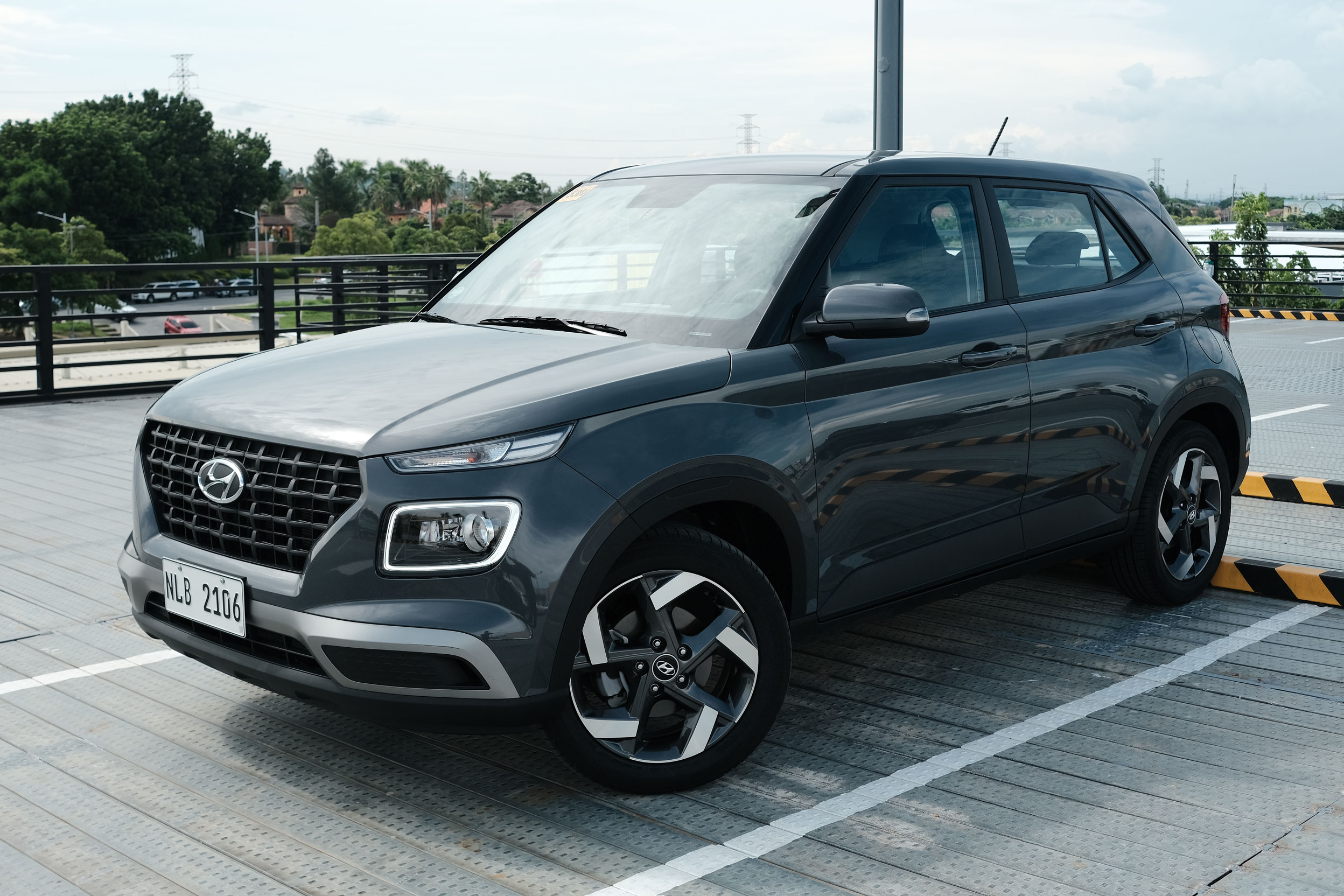
The Hyundai Venue isn’t trying to reinvent the subcompact crossover formula, and we think that’s exactly why it works.
There are cars that try to impress you with massive touchscreens, countless drive modes, and an endless list of technology features. Then there’s the Hyundai Venue GLS, a subcompact crossover that takes a much simpler approach.
After spending time behind the wheel during our weekend drive around Laguna and bringing it on our daily office commute, we quickly realized that the Venue’s biggest strength isn’t any single feature—it’s how everything simply works together.
For buyers looking for an affordable crossover that prioritizes ease of use over unnecessary complexity, the Venue might just be one of Hyundai’s most underrated offerings today.
Exterior Design

The Venue’s front fascia strikes a good balance between practicality and modern styling without resorting to overly aggressive design cues seen on some of today’s compact crossovers. Its distinctive lighting arrangement places the main headlamps midway down the front bumper, while the turn signal lamps sit higher up near the hood line. Dominating the nose is a large black grille finished with a chrome Hyundai emblem, giving the Venue a clean and purposeful appearance.
Rear Design

At the rear, the Venue continues its practical and understated design language. The taillights feature a clean, uncomplicated layout, complemented by neatly placed Hyundai and Venue badging on the tailgate. What stood out to us, however, was how the squared-off body lines carry through to the rear, giving the crossover a more planted and substantial presence than its compact dimensions suggest. Rather than looking like a small city car, the Venue projects the confidence of a proper crossover, making it feel right at home alongside larger vehicles on the road.
Body Design and Road Presence

Viewed from the side, the Hyundai Venue carries a clean and purposeful profile highlighted by sharp character lines and its signature boxy proportions. Its modest ground clearance and comfortable ride height strike a practical balance for everyday driving, making ingress and egress easy while still providing the elevated seating position that many crossover buyers appreciate. Although the design remains understated, the strong body lines running from front to rear give the Venue a solid and well-planted stance, allowing it to project the presence of a genuine crossover despite its compact footprint.
Interior Design

Cabin Layout
One thing we appreciated almost immediately was the straightforward interior.
Unlike many newer vehicles that move almost every function into the touchscreen, the Venue still keeps physical buttons for climate controls and frequently used functions. It makes everyday driving easier because you spend less time looking for controls and more time focusing on the road.
Material quality is what you’d expect for the price point, but everything feels well assembled. More importantly, the cabin feels airy thanks to its upright design and generous glass area.

Steering Wheel and Instrument Cluster
Behind the wheel, the Venue immediately feels well sorted for everyday driving. The steering has a reassuring heft to it—light enough to make parking and low-speed maneuvers effortless, yet weighted sufficiently to inspire confidence at highway speeds. Hyundai also got the steering wheel size just right. It feels natural in the hands, striking a balance between comfort and control without being overly large or too compact.

The multifunction steering wheel keeps things straightforward, offering controls for the audio system and the digital instrument cluster. While the Venue GLS does without cruise control, its absence isn’t particularly surprising given the vehicle’s positioning in the more affordable end of the crossover segment. Instead, Hyundai focuses on providing the essentials that most drivers will use on a daily basis.

Practicality
One of the Venue’s strongest practicality features is its infotainment system. Hyundai equips the Venue GLS with wireless Apple CarPlay and Android Auto, eliminating the need to plug in your phone every time you get behind the wheel. While wireless smartphone connectivity is becoming more common, it’s still not something you’ll find across every crossover in this price range, making it a welcome convenience for daily driving. During our time with the vehicle, it quickly became one of those features we appreciated the most.

The touchscreen itself isn’t the largest in its segment, but Hyundai makes up for it with a thoughtful layout. Instead of relying entirely on touch inputs, the system retains dedicated physical buttons positioned below the display for commonly used functions. It’s a practical decision that makes the infotainment system easier to operate while on the move, especially for drivers who prefer tactile controls or aren’t as comfortable navigating touchscreens. Sometimes, keeping the essentials simple is the better approach.


Engine & Performance
Under the hood, the Hyundai Venue takes a slightly different approach compared to many of its rivals. Instead of adopting the increasingly common 1.5-liter engine found in several competitors—and even in some of Hyundai’s own models such as the Creta—the Venue is powered by a larger 1.6-liter Smartstream naturally aspirated gasoline engine.
At first glance, the decision may seem unusual for a crossover of this size. However, Hyundai’s choice reflects a different engineering philosophy. Rather than focusing solely on downsizing, the company opted for a well-proven naturally aspirated powertrain that emphasizes smooth, predictable performance, long-term reliability, and simpler maintenance. The additional displacement also helps provide stronger low- and mid-range response, making the Venue feel more relaxed in everyday city driving where frequent acceleration from a standstill is common.

Transmission
Power is sent to the front wheels through Hyundai’s Intelligent Variable Transmission (IVT), a transmission designed to deliver smoother acceleration while minimizing the rubber-band effect commonly associated with traditional CVTs. During our time with the Venue, the powertrain proved to be well suited for daily commuting. Acceleration felt linear and easy to modulate, while the transmission remained unobtrusive during normal driving conditions.

While a larger-displacement engine may not deliver the same fuel economy figures as some smaller alternatives on paper, the trade-off is a powertrain that feels refined, straightforward, and confidence-inspiring. It may not be the fastest crossover in its class, but for drivers looking for predictable performance and hassle-free everyday usability, the Venue’s combination of the 1.6-liter engine and IVT transmission makes a compelling case.

Cargo Space
One area where the Hyundai Venue genuinely surprised us was its cargo capacity. Despite being one of the smaller crossovers in Hyundai’s lineup, the rear cargo area is more accommodating than its compact footprint suggests. With the rear seats in place, the Venue offers approximately 355 liters of luggage space—more than enough for a few carry-on suitcases, grocery runs, or a weekend’s worth of luggage.
Need to haul larger items? The Venue’s 60:40 split-folding rear seats make it easy to expand the cargo area when needed, increasing practicality for bulkier loads such as bicycles, camping equipment, or even furniture from a quick trip to the home improvement store. With the rear seats folded flat, cargo capacity grows to around 903 liters, giving the Venue a level of versatility that many buyers will appreciate.
Driving Experience
We spent the weekend using the Hyundai Venue the way many owners would—as a daily commuter. Our route took us from Santa Rosa, Laguna to Bonifacio Global City (BGC) in Taguig, covering everything from provincial roads and city traffic to expressway cruising. It proved to be an excellent opportunity to see how the Venue performs in real-world driving conditions rather than in a controlled test environment.
Around town, the Venue immediately impressed us with its ride quality. Despite riding on relatively compact dimensions, the suspension absorbed road imperfections, expansion joints, and uneven provincial roads remarkably well. The ride never felt overly stiff or “matagtag,” even with only two occupants onboard. Instead, it maintained a comfortable balance between firmness and compliance, making long hours behind the wheel surprisingly relaxing.

On the expressway, the Venue continued to inspire confidence. Naturally, its taller crossover stance means crosswinds become more noticeable at speeds of around 100 km/h compared to a lower sedan. However, what stood out was how composed it remained. The steering retained a reassuring weight at highway speeds, preventing the light or nervous sensation we’ve experienced in some subcompact sedans. Rather than feeling like the vehicle was becoming unsettled as speeds increased, the Venue stayed planted and predictable, giving us greater confidence during long highway stretches.
The Venue’s compact dimensions also became one of its biggest advantages in traffic. Whether weaving through congested city streets or negotiating tighter corners, it remained easy to position on the road without sacrificing the elevated driving position and solid feel expected from a crossover. It offers the maneuverability of a small car while still delivering the commanding view and confidence that many buyers look for in this segment.


Another feature that deserves recognition is the Venue’s braking system. Hyundai equips the Philippine-spec Venue GLS with four-wheel disc brakes—something that’s still relatively uncommon at this price point, where many competitors continue to pair front disc brakes with rear drum brakes. While most buyers may never think about it during a test drive, the four-disc setup contributes to a more reassuring braking feel and reinforces the Venue’s premium character.

One small detail that genuinely surprised us was the inclusion of cornering lamps. Whenever the headlights are switched on, an additional lamp illuminates the direction you’re turning, improving visibility when navigating darker intersections or tight corners at night. It’s a feature more commonly associated with higher-end vehicles equipped with Adaptive Front-lighting Systems (AFS), making its inclusion in the Venue a thoughtful addition that enhances everyday usability. It’s one of those subtle features that may go unnoticed at first—but once you’ve experienced it, it’s hard not to appreciate having it.

As of writing, the Hyundai Venue is offered in three variants in the Philippines:
• 1.6 GLS 6AT (our test vehicle) – ₱998,000
• 1.6 GL 6AT – ₱898,000
• 1.6 GL 6MT – ₱798,000
During our Road Test, we spent the weekend with the top-spec Venue GLS priced at ₱998,000. Considering everything it brings to the table—from wireless Apple CarPlay and Android Auto, four-wheel disc brakes, cornering lamps, a refined 1.6-liter engine paired with Hyundai’s Intelligent Variable Transmission (IVT), and an overall driving experience that exceeded our expectations—we’d say it offers excellent value for money while still remaining below the one-million peso mark.
Regarding fuel economy, the Hyundai Venue returned approximately 11.6 km/L in city driving around Bonifacio Global City and 16.8 km/L during our highway run. Based on our overall weekend route covering both urban traffic and expressway cruising, we estimate a mixed fuel economy of around 14.2 km/L. While it may not match the fuel efficiency of some smaller 1.5-liter engines on paper, the Venue compensates with its smooth power delivery, relaxed driving character, and the simplicity of its naturally aspirated 1.6-liter engine paired with Hyundai’s Intelligent Variable Transmission (IVT).
Fuel economy figures were obtained during the Road Spec PH Road Test under real-world driving conditions. Actual results may vary depending on traffic, weather, passenger load, and driving style.
For buyers working with a tighter budget but who still prefer the convenience of an automatic transmission, the mid-spec GL 6AT at ₱898,000 makes a compelling alternative. It retains the same 1.6-liter engine and automatic gearbox while offering a more accessible entry point into the Venue lineup. Meanwhile, if maximizing value is the priority and you’re comfortable driving a manual, the GL 6MT starts at just ₱798,000, making it one of the most affordable subcompact crossovers currently available from Hyundai Philippines.
Whichever variant you choose, Hyundai has kept the Venue lineup straightforward. Rather than overwhelming buyers with numerous trim levels, each variant is clearly positioned to suit different budgets, making it easier to decide based on your needs and preferred transmission.
Verdict: Would We Buy the Hyundai Venue as Our First Car?

Absolutely—yes.
After spending an entire weekend with the Hyundai Venue GLS, it’s easy to understand why it remains one of Hyundai’s most underrated offerings. It may not have the biggest touchscreen, the most powerful engine, or the longest list of premium features in its class, but what it does offer is a package that’s honest, practical, and incredibly easy to live with.
For a first-time car buyer, the Venue checks many of the right boxes. It delivers a comfortable ride without feeling overly soft, remains composed and confidence-inspiring on the highway, and its compact dimensions make navigating city traffic and tight parking spaces far less intimidating. The elevated driving position also provides excellent visibility, giving new drivers an added sense of confidence behind the wheel.
Beyond its driving manners, Hyundai has included several thoughtful features that genuinely improve the ownership experience. Wireless Apple CarPlay and Android Auto, four-wheel disc brakes, intuitive physical controls for the infotainment system, and cornering lamps are all features that aren’t always expected at this price point but make a noticeable difference in day-to-day use.
The 1.6-liter naturally aspirated engine paired with Hyundai’s Intelligent Variable Transmission may not be the most exciting combination on paper, but it delivers smooth, predictable performance that suits daily commuting exceptionally well. More importantly, its simplicity should also appeal to buyers who value long-term reliability and ease of ownership.
If we were shopping with a budget for our very first car today, the Hyundai Venue would easily make our shortlist—and after spending quality time behind the wheel, we’d have no hesitation choosing it. It isn’t a crossover that tries to impress with gimmicks or flashy technology. Instead, it focuses on getting the fundamentals right, and sometimes, that’s exactly what matters most.
All photos © Kevin Peters / Road Spec PH. All rights reserved.
About the Author

Kevin Peters
Kevin, or Kev, is the Founder & Editor of Road Spec PH, a passion project born from a lifelong love of cars and automotive culture.
Long before working in the Philippine automotive industry, Kevin was already the kid who collected toy cars, spent countless hours playing Gran Turismo, and proudly told anyone who would listen that he wanted to be a race car driver when he grew up. While that racing career never quite happened, the passion for cars never went away.
When he’s not writing for Road Spec PH, you’ll probably find him playing racing simulators, adding to his die-cast car collection, or spending time with his 2016 Mitsubishi Lancer EX.