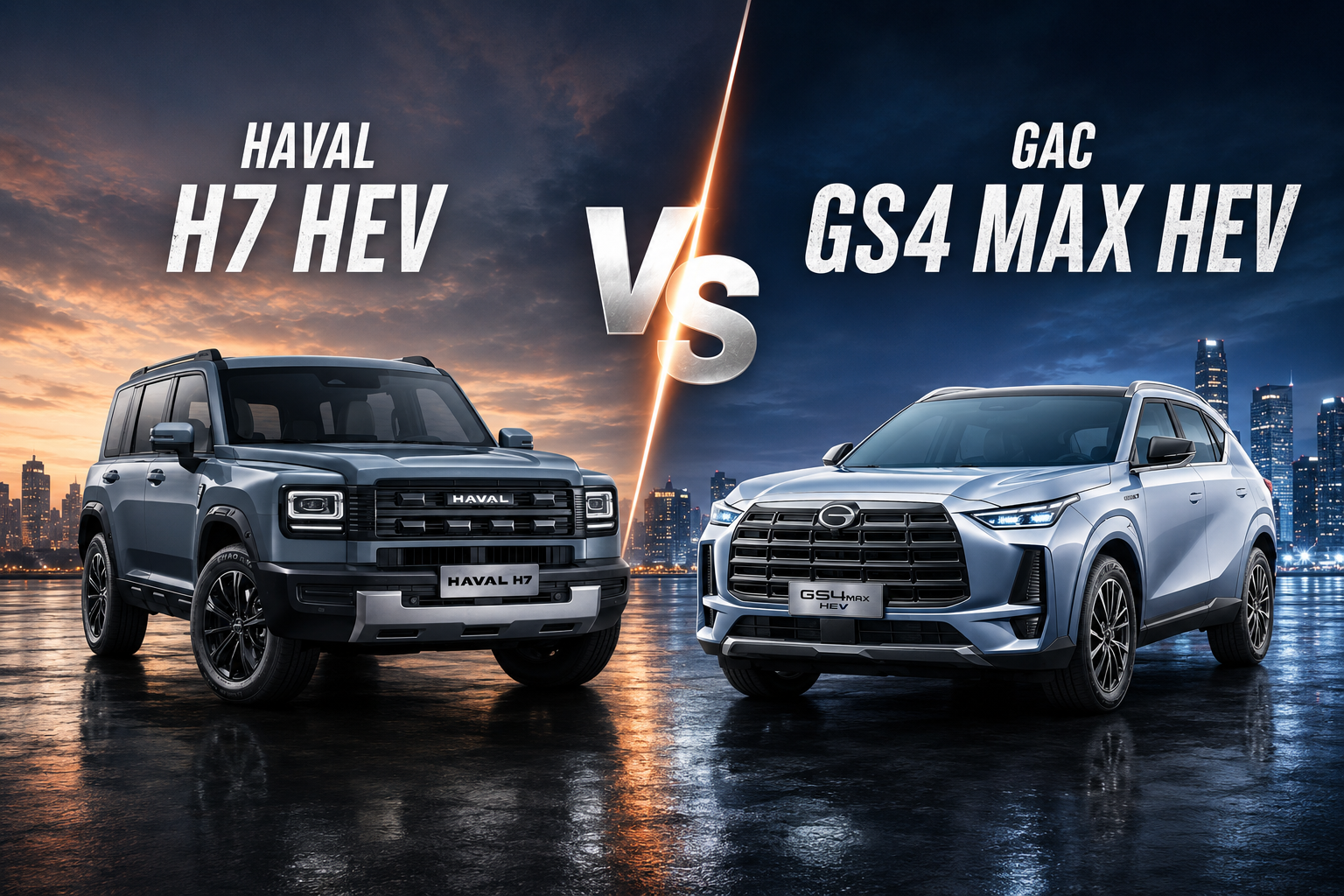
The arrival of the GAC GS4 MAX HEV has created an unusually close matchup in the Philippine hybrid SUV market. At their regular suggested retail prices, the GAC costs ₱1,298,000, while the GWM Haval H7 HEV 2WD is priced at ₱1,298,888 — a difference of just ₱888. GAC is currently making that gap much wider with an introductory ₱1,218,000 price for reservations made until September 30, 2026.
That near-identical regular pricing makes this less about budget and more about priorities. The Haval H7 is the physically larger and more rugged-looking SUV, with a slightly stronger quoted hybrid output, considerably more ground clearance, larger screens, and a longer standard warranty. The GS4 MAX HEV counters with a longer wheelbase despite its smaller footprint, eight airbags, a full Level 2 driver-assistance suite, and a current promotional price that undercuts the Haval by more than ₱80,000.
The Numbers (Quick Glance)
| Specification | GAC GS4 MAX HEV | GWM Haval H7 HEV 2WD |
| Regular SRP | ₱1,298,000 | ₱1,298,888 |
| Powertrain | 2.0L Atkinson HEV | 1.5L turbo HEV |
| Transmission | 2-speed DHT | DHT |
| Battery | 2.1 kWh NCM | 1.53 kWh |
| Combined output | 232 hp | 247 PS / about 244 hp |
| Drivetrain | FWD | FWD |
| Length x Width x Height | 4,685 mm x 1,901 mm x 1,690 mm | 4,800 mm x 1,950 mm x 1,843 mm |
| Wheelbase | 2,750 mm | 2,738 mm |
| Ground clearance | 158 mm | 200 mm |
| Seating | 5 | 5 |
| Fuel tank | 50L | 61L |
| Wheels | 18-inch | 18-inch |
| Rear suspension | Multi-link | Multi-link |
| Instrument display | 7-inch | 12.3-inch |
| Infotainment | 10.1-inch | 15.6-inch |
| Speakers | 4 | 8 |
| Wireless charger | 50W | 50W |
| Surround camera | 360-degree | 540-degree |
| Airbags | 8 | 6 |
| Adaptive cruise / L2 ADAS | Yes | No full ADAS suite on HEV 2WD |
| Basic warranty | 5 years / 150,000 km | 7 years / 200,000 km |
Only ₱888 separates their regular prices
At regular SRP, there is effectively no meaningful price difference between the two: ₱888 is less than the cost of a full tank of fuel. That makes the specification differences far more important than the sticker price, because someone with around ₱1.3 million to spend could realistically walk into either showroom without having to change the budget.
Under the hood, GAC uses a naturally aspirated 2.0-liter Atkinson-cycle engine, a 2.1kWh NCM battery, and a two-speed Dedicated Hybrid Transmission. GAC quotes 232 hp of combined output, while the electric motor itself is rated at 134kW and 300Nm; the company also claims 20.83 km/L under UDDS testing and as much as 1,250 km of combined range from the 50-liter tank. Those efficiency and range figures are manufacturer claims and are not directly comparable with the Haval without testing both vehicles under the same conditions.

The Haval takes a different approach with a 1.5-liter turbocharged four-cylinder engine, 1.53kWh battery, electric motor and GWM’s Dedicated Hybrid Transmission. CarGuide.PH and AutoIndustriya list the HEV at 247 PS and 540Nm of combined torque, while Top Gear Philippines expresses the output as roughly 244hp because of the difference between PS and horsepower units. It remains front-wheel drive just like the GAC, so the H7’s rugged appearance should not be confused with the four-wheel-drive system available on the much more expensive H7 Hi4 PHEV 4WD.
On paper, the Haval therefore has a modest output advantage rather than an overwhelming one. The GAC’s 232hp versus the Haval’s roughly 244hp makes this considerably closer than the 540Nm figure alone might suggest, particularly because GAC does not publish a directly comparable total-system torque number. A proper performance winner would require instrumented acceleration and road testing rather than simply adding up specification-sheet figures.

The Haval is bigger, but the GAC has the longer wheelbase
The Haval H7 measures 4,800mm long, 1,950mm wide, and 1,843mm tall, making it 115mm longer, 49mm wider and 153mm taller than the GS4 MAX HEV. It also has 200mm of ground clearance on the 2WD variants compared with the GAC’s 158mm, and its boxier body, roof rails and rear-mounted spare reinforce the more traditional SUV appearance. Both use MacPherson-strut front and multi-link rear suspension layouts.

The interesting number is wheelbase. Despite the Haval’s larger exterior, its 2,738mm wheelbase is actually 12mm shorter than the GAC’s 2,750mm, so overall exterior size does not automatically translate into a larger passenger compartment. GAC claims 990mm of second-row legroom and says the rear seats can fold flat to create a load area roughly 2.0 meters long and 1.02 meters wide.

Both are five-seaters, but they approach practicality differently. The H7 has the bigger 61-liter fuel tank, more ground clearance and a full-size rear-mounted spare, while the GS4 MAX carries a 50-liter tank and temporary spare. The Haval’s greater height and clearance may appeal more to buyers dealing with rougher roads, while the GAC’s smaller exterior footprint could be easier to live with in tighter urban environments.

Haval wins the screen war, while GAC packs in more driver assistance
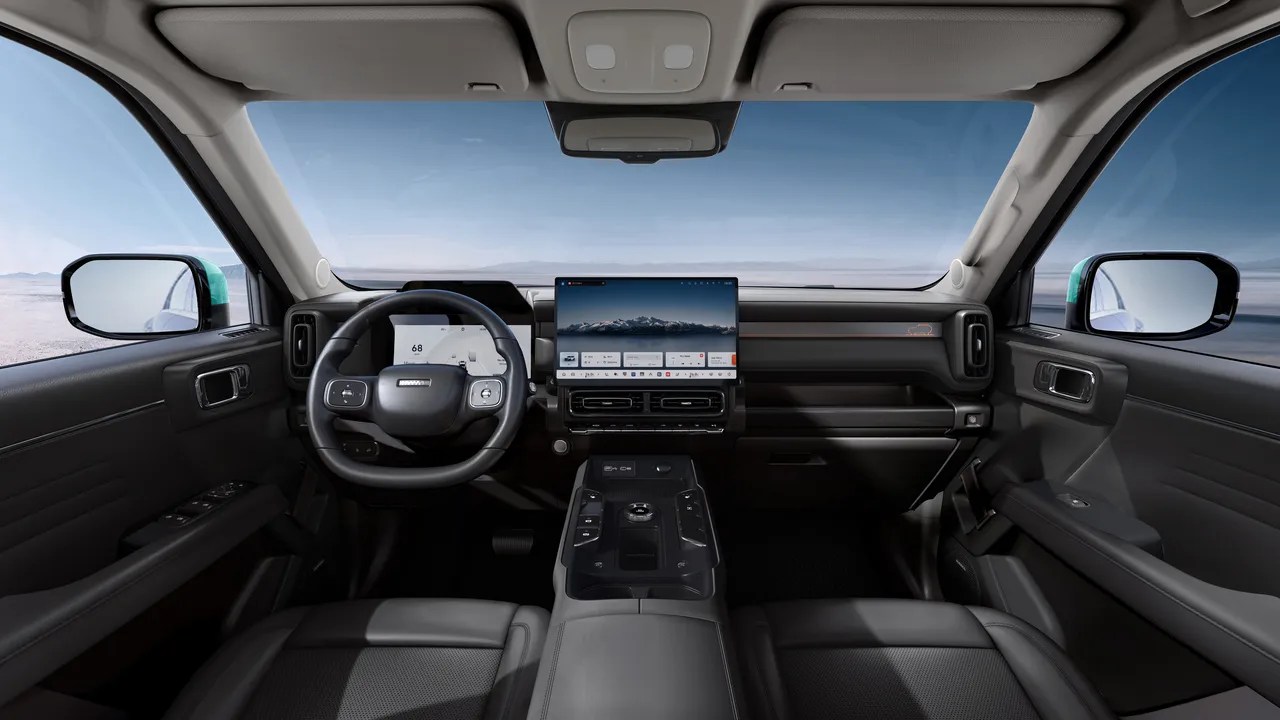
Inside, the Haval H7 HEV has the clearer technology advantage if screen size matters. Philippine specifications list a 12.3-inch digital instrument cluster and 15.6-inch infotainment display with wireless Apple CarPlay and Android Auto, an eight-speaker system, 50W wireless charging, dual-zone climate control with rear vents, a powered driver’s seat, ventilated front seats and a cooled center-console compartment. The cabin also gets leather-style upholstery and a panoramic sunroof.
The GS4 MAX HEV is more modest in this area, using a 7-inch digital instrument cluster and 10.1-inch touchscreen, although Apple CarPlay and Android Auto, a cooled 50W wireless charger, panoramic glass roof, rear air vents and a six-way powered driver’s seat are standard. Audio comes through only four speakers, and GAC specifies PVC synthetic-leather upholstery. The GAC does get electric hidden exterior door handles, although its official Philippine specification currently lists manually folding side mirrors.

Safety and driver assistance turn the comparison in the other direction. GAC says the GS4 MAX HEV has eight airbags and 10 Level 2 assistance functions, with adaptive cruise control, forward-collision warning, autonomous emergency braking, lane departure warning, lane keeping, traffic-jam assist and integrated cruise assist among the systems included; a surround-view camera is also standard.
The H7 HEV still carries a substantial conventional safety package, including six airbags, stability and traction control, hill-start and hill-descent systems, tire-pressure monitoring, front and rear parking sensors, and GWM’s 540-degree camera system. The important distinction is that CarGuide.PH’s variant-specific specification sheet says the 2WD HEV and 2WD PHEV receive conventional cruise control, while the comprehensive ADAS suite is reserved for the Hi4 PHEV 4WD; Top Gear Philippines likewise notes that the full driver-assistance package is limited to the 4WD model.

So where would ₱1.3 million go?
The Haval H7 HEV makes the stronger case for buyers who want more physical SUV for the money. It is larger in nearly every exterior dimension, has substantially more ground clearance, slightly more quoted hybrid output, a bigger fuel tank, larger displays, more speakers and several cabin conveniences that the GAC does not match. GWM also backs the H7 with a particularly aggressive ownership package: CarGuide.PH reports a seven-year/200,000km bumper-to-bumper warranty, 10-year/1,000,000km powertrain warranty and eight-year/200,000km battery warranty.


Photos : GWM Philippines. Actual unit may vary.
The GS4 MAX HEV makes the stronger case for buyers prioritizing active safety, a slightly more city-friendly footprint and current purchase price. Its eight-airbag setup and standard Level 2 assistance package are significant equipment advantages at this price, and its longer wheelbase is notable given that the body itself is considerably shorter than the Haval. GAC provides a five-year/150,000km basic warranty and eight-year/150,000km coverage for the hybrid battery, drive motor and motor control unit, alongside two years of roadside assistance.


Photos : GAC Philippines. Actual unit may vary.
If both were sitting at their regular SRPs, the decision would come down almost entirely to what the buyer values because ₱888 is functionally no price difference at all. The Haval puts more emphasis on size, ruggedness and cabin hardware, while the GAC trades some of that physical presence for stronger standard driver-assistance equipment and a hybrid package for which GAC is already publishing specific efficiency and range claims.
For buyers shopping before September 30, however, GAC’s ₱1.218-million introductory price cannot be ignored. An ₱80,888 saving is large enough to materially change the comparison, especially when the GS4 MAX retains advantages such as eight airbags and Level 2 ADAS. Once that introductory offer ends, this goes back to being one of the closest spec-for-spec hybrid SUV battles around ₱1.3 million in the Philippine market.

About the Author

Kevin Peters
Kevin, or Kev, is the Founder & Editor of Road Spec PH, a passion project born from a lifelong love of cars and automotive culture.
Long before working in the Philippine automotive industry, Kevin was already the kid who collected toy cars, spent countless hours playing Gran Turismo, and proudly told anyone who would listen that he wanted to be a race car driver when he grew up. While that racing career never quite happened, the passion for cars never went away.
When he’s not writing for Road Spec PH, you’ll probably find him playing racing simulators, adding to his die-cast car collection, or spending time with his 2016 Mitsubishi Lancer EX.