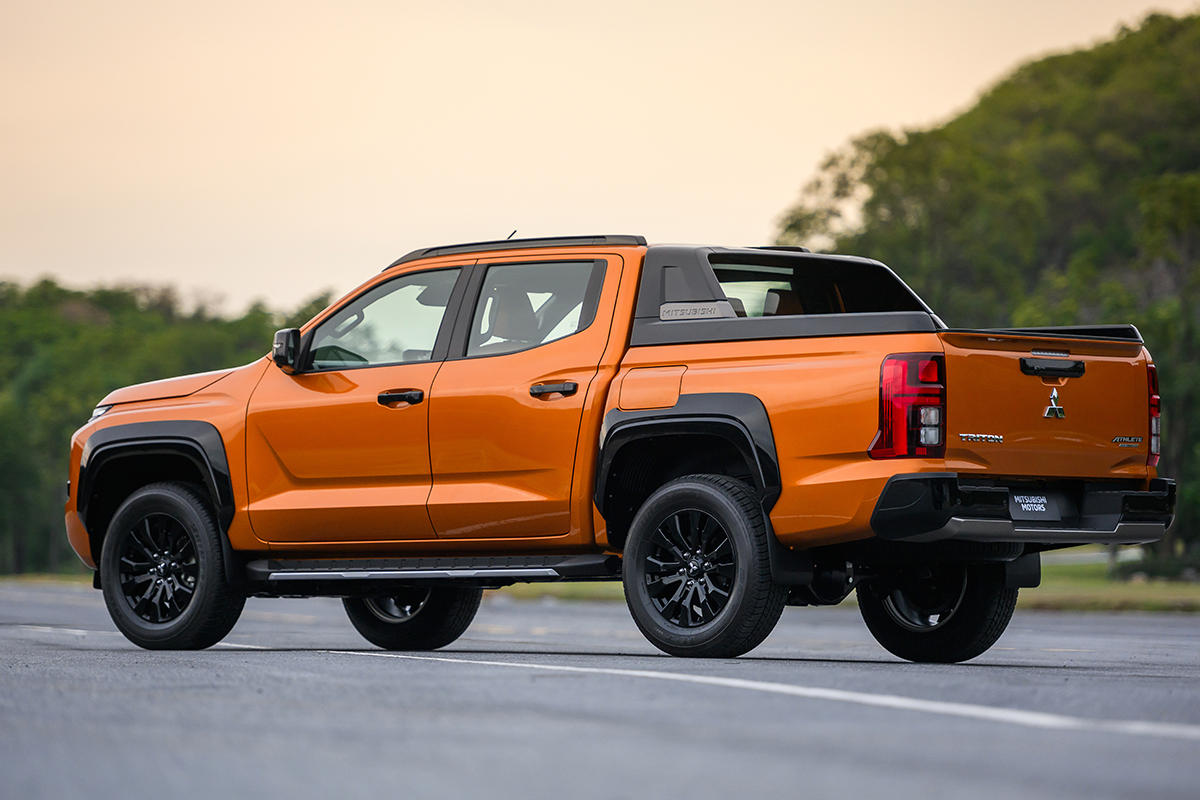
Mitsubishi Motors’ newest SUVs give us a reason to look again at the Mitsubishi Triton. Across the XForce, Destinator, and newly revealed Pajero, distinctive lighting and strong horizontal lines create an increasingly recognizable family resemblance. For Philippine pickup buyers, that raises an interesting question: could a future Triton update bring those ideas into the truck’s design?
As of September 7, 2026, we have found no official announcement of a Pajero-inspired facelift for the Philippine-market Triton. This feature examines Mitsubishi’s confirmed production designs; the proposed Triton changes are Road Spec PH analysis.

Mitsubishi’s family resemblance is becoming clearer
The XForce offers an early reference point. Mitsubishi describes its front as an evolution of Dynamic Shield, with daytime running lights that combine L-shaped elements and slitted accents into a T-shaped signature. The rear lights repeat that motif, giving the compact SUV a recognizable appearance from either direction.

The Destinator develops that approach through stronger horizontal and vertical elements around its grille, lights, and bumpers. Mitsubishi also connects its hexagonal rear design to the spare tires carried by earlier Pajeros. That provides a deliberate link between the brand’s newer family vehicles and its off-road heritage.

The new Pajero brings upright proportions, prominent fenders, T-shaped headlights, and a choice of horizontal-bar or honeycomb grilles. Our reading is that these models share an emphasis on width and clearly defined shapes, even though each applies those ideas differently. A future Triton could strengthen its resemblance to that family while retaining the proportions and character of a pickup.

The current truck already participates in that design language. Its sixth generation debuted in July 2023 with Mitsubishi’s Beast Mode design concept, three L-shaped daytime running lights on each side, and T-shaped rear lights. Any future adoption of a stronger T-shaped lighting signature would therefore be an evolution of existing themes, particularly at the front.
The Pajero–Triton connection goes beneath the bodywork
There is a confirmed engineering relationship behind this discussion. Mitsubishi’s earlier Pajero announcement states that the SUV uses the Triton’s ladder frame as its foundation, with model-specific development of the cabin and front and rear suspension. That makes the two vehicles relevant points of comparison, although shared foundations do not establish a plan to exchange body panels or equipment.

For an eventual facelift, we would look first at how Mitsubishi might reorganize the Triton’s grille, lighting, and bumper. A more continuous horizontal treatment could visually connect the lamps, while a different arrangement of the protective trim could give the nose a cleaner appearance. Those are possible directions for the design, with no confirmed production changes behind them.
Mitsubishi has already demonstrated that the current Triton can accommodate a different front-end treatment. The Thailand-exclusive Triton Mega Cab Street has its own grille design and 17-inch wheels, along with a 10-inch infotainment system. It is an existing market-specific version, so its appearance does not confirm a broader facelift or a Philippine introduction.
At the rear, revised lighting graphics and tailgate detailing could create a closer visual relationship with Mitsubishi’s newer SUVs. Different wheels and finishes could also distinguish the grades. We would want those changes to preserve useful bumper steps, cargo access, and the visibility of the lamps—details that matter once the truck starts working.
The cabin and drivetrain deserve attention, too
The Philippine Triton Athlete currently lists a 9-inch touchscreen, a 4N16 diesel engine, a six-speed automatic, and Super Select 4WD-II. Those provide a concrete starting point when considering what Mitsubishi Motors Philippines Corporation’s pickup customers might want from a future update. A larger display could be welcome, particularly if it improves the readability of maps and camera views.

The Pajero’s integrated display arrangement offers another possible source of inspiration. However, fitting its complete dashboard into the Triton would be a much bigger proposition than updating the infotainment system or instrument graphics. Our preference would be for clearer information and responsive controls, with frequently used functions remaining easy to operate.
The drivetrain comparison is also worth watching. Mitsubishi confirms that the new Pajero pairs a 2.4-liter diesel using a wide-range single variable-geometry turbocharger with a newly developed eight-speed automatic. That invites questions about whether later Triton development could draw on similar hardware, but the Pajero announcement does not confirm such a transfer.

An additional two gears alone would not tell buyers whether an updated pickup drives better. Shift behavior, response under load, cruising refinement, and fuel consumption would matter more in daily use. Those qualities would need to be assessed in an actual production vehicle.
What would make a future Triton update worthwhile in the Philippines?
For Philippine buyers, a more cohesive design would be an appealing starting point. Its value would depend on the equipment and price attached to it, particularly across the grades that people can realistically afford. A refreshed flagship would attract attention, but useful improvements reaching more of the range would give buyers a stronger reason to consider the truck.
Our wishlist would include better camera visibility, straightforward smartphone connectivity, comfortable seating, and driver-assistance systems that work predictably in local traffic. We would also want Mitsubishi to retain the practical details that make a pickup easy to live with. An impressive cabin still needs to accommodate work gear, muddy footwear, and regular loading duties.
The new Pajero makes the Triton’s eventual evolution an interesting design question. Its connection to the pickup gives us something concrete to examine, while the XForce and Destinator show how Mitsubishi adapts recognizable motifs to different vehicles. A future Triton could take that family resemblance further, provided the result still serves the people buying a truck.
Would you prefer a Triton with more of the Pajero’s appearance—or would cabin technology, refinement, and pricing have a greater influence on your decision?